
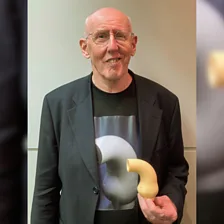
Twenty-two years after becoming the first recipient of the personalised external aortic support he helped develop, engineer and Exstent founder Tal Golesworthy has shared the remarkable story behind ExoVasc® with BBC World Service’s Outlook.
When Tal Golesworthy was diagnosed with a dilated aortic root associated with Marfan syndrome, he approached the problem not only as a patient, but as an engineer.
Over eight years of monitoring, Tal watched his aortic root increase from 4.4 cm to 5 cm. When the time came to consider surgical intervention, he began asking whether there could be another way to approach the underlying mechanical problem.
His question was deceptively simple: could the patient’s own aorta be supported externally rather than replaced?
An engineering question with a clinical answer
Speaking to presenter Jo Fidgen on BBC World Service’s Outlook, Tal describes how his engineering background led him to think differently about aortic dilatation.
The concept was to use medical imaging to capture the individual anatomy of the patient’s aorta, translate that data into a computer-aided design model and use the model to create a personalised external support.
Turning that concept into reality required far more than engineering.
Tal’s idea led to collaboration with Professor Tom Treasure, cardiac surgeon John Pepper and engineers from Imperial College London, combining expertise in aortic anatomy, cardiothoracic surgery, medical imaging, computer-aided design and manufacturing.
After four years of development, Tal became the first patient to undergo the procedure in May 2004.
Twenty-two years as the first patient
Today, Tal occupies a unique position in the history of ExoVasc®: engineer, inventor and Patient No. 1.
During the BBC interview, he reflects openly on both the technical and deeply personal sides of that journey, including the uncertainty involved in developing a new approach while simultaneously living with the condition it was intended to address.
He also describes his own long-term follow-up. Twenty-two annual postoperative MRI studies have followed his aorta since the first procedure, which Tal reports has remained dimensionally stable.
But his story did not end with his own operation.
From one patient to an international clinical community
What began with one patient’s question has subsequently moved into clinical practice internationally.
During the interview, Tal describes approximately 1,850 reported procedures performed across around 50 surgical centres in 15 countries.
For Tal, however, the significance of that journey is ultimately measured in people rather than numbers.
He describes the patients who have undergone the procedure as his “fellow travellers” and says that many simply recover and return to their everyday lives.
As he tells Jo Fidgen, that is exactly what he wants: patients to “get well” and “get on with the rest of your life.”
It is a fitting perspective from the person whose own diagnosis started the journey more than two decades ago.
Listen to Tal Golesworthy’s full interview, “The engineer who invented a fix for his own heart condition”, on BBC Sounds.